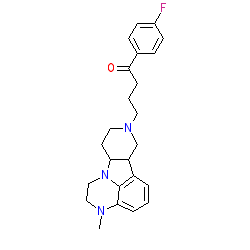
|
Synonyms: Caplyta® | ITI-007

lumateperone is an approved drug (FDA (2019))
Compound class:
Synthetic organic
Comment: Lumateperone (ITI-007) is an antipsychotic, with a novel mechanism of action, making it the first-in class agent of its type [3,6]. Note that the approved drug contains lumateperone tosylate (PubChem CID 44241743).

Ligand Activity Visualisation ChartsThese are box plot that provide a unique visualisation, summarising all the activity data for a ligand taken from ChEMBL and GtoPdb across multiple targets and species. Click on a plot to see the median, interquartile range, low and high data points. A value of zero indicates that no data are available. A separate chart is created for each target, and where possible the algorithm tries to merge ChEMBL and GtoPdb targets by matching them on name and UniProt accession, for each available species. However, please note that inconsistency in naming of targets may lead to data for the same target being reported across multiple charts. ✖ |
|
|||||||||||||||||||||||||||||||||||
| No information available. |
Summary of Clinical Use  |
| Lumateperone was initially progressed to clinical trials for the treatment of schizophrenia, bipolar depression, and Alzheimer's disease (principally to manage agitation) [2]. In Phase 1 and Phase 2 clinical trials, lumateperone treatment demonstrated improved sleep maintenance, antipsychotic efficacy, and clinical signals consistent with reduction in negative symptoms associated with schizophrenia, depression and anxiety, and other symptoms associated with impaired social function. FDA approval as a treatment for schizophrenia was granted in December 2019. Since then, potential clinical indications and trials have been expanded to include bipolar disorder (mania), treatment resistant depression, stuttering, social anxiety disorder and irritability associated with autism spectrum disorder. |
| Mechanism Of Action and Pharmacodynamic Effects |
| Lumateperone simultaneously modulates serotonin, dopamine, and glutamate signalling, which are three neurotransmitter pathways that are implicated in severe mental illness. Low dose lumateperone behaves as a highly potent 5-HT2A receptor antagonist. As the dose is increased, engagement with additional molecular targets occurs with the compound showing modest dopamine receptor modulation and modest inhibition of serotonin transporters [5]. In relation to its effects on dopamine signalling via D2 receptors, lumateperone acts as a pre-synaptic partial agonist and post-synaptic antagonist. |
| Clinical Trials | |||||
| Clinical Trial ID | Title | Type | Source | Comment | References |
| NCT06706674 | Multicenter Study of Lumateperone for the Treatment of Irritability Associated With Autism Spectrum Disorder (ASD) in Pediatric Patients | Phase 3 Interventional | Intra-Cellular Therapies, Inc. | ||
| NCT07623135 | Lumateperone for Late-Life Depression | Phase 3 Interventional | Washington University School of Medicine | ||
| NCT07734103 | Lumateperone in the Treatment of Stuttering, Childhood Onset Fluency Disorder | Phase 2 Interventional | CSTrials Inc. | ||
| NCT07747389 | A Study of Lumateperone Versus Placebo in Participants With Major Depressive Disorder | Phase 3 Interventional | Intra-Cellular Therapies, Inc. | ||
| NCT07799493 | Caplyta Versus Placebo for Adults With Social Anxiety Disorder | Phase 4 Interventional | IMA Clinical Research | ||
| NCT04959032 | Lumateperone for the Prevention of Relapse in Patients With Schizophrenia | Phase 3 Interventional | Intra-Cellular Therapies, Inc. | ||
| NCT02469155 | A Trial to Assess the Antipsychotic Efficacy of ITI-007 Over 6 Weeks of Treatment | Phase 3 Interventional | Intra-Cellular Therapies, Inc. | 1 | |