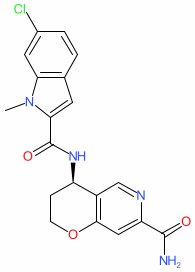
|
Compound class:
Synthetic organic
Comment: RTY-406 is an orally bioavailable dual ABCB4 (MDR3)/ABCB11 (BSEP) positive functional modulator. It targets core pathophysiological drivers of hepatobiliary disease, abnormal bile composition and reduced bile flow. Upregulating the transport functions of these proteins, rectifies these abnormalities, and intimates the application of RTY-406 as a disease modifying therapy for cholangitis/hepatobiliary indications.
|
|
|||||||||||||||||||||||||||||||||||
| Bioactivity Comments |
| In mouse models and non-human primates RTY-406 significantly improves multiple markers of primary sclerosing cholangitis (PSC), reducing inflammation, cholangitis, cholestasis, and fibrosis. |
| Targets where the ligand is described in the comment field | |
| Target | Comment |
| ABCB4 | Transports phosphatidylcholine from intracellular to extracellular face of the hepatocyte canalicular membrane [4]. Heterozygous ABCB4 variants contribute to mild cholestatic phenotypes, while homozygous deficiency leads to Progressive Intrahepatic Familial Cholestasis (PFIC) Type 3, and increased risk of cholesterol gallstones [2]. RTY-406 has been designed as a dual ABCB4 (MDR3)/ABCB11 (BSEP) positive functional modulator as a potentially disease modifying therapy for cholangitis/hepatobiliary indications. |
| ABCB11 | Loss-of-function mutations are associated with progressive familial intrahepatic cholestasis type 2 [5]. ATP-dependent transport of bile acids into the confines of the canalicular space by ABCB11 (BSEP) generates an osmotic gradient and thereby, bile flow. Mutations in BSEP that decrease its function or expression cause Progressive Familial Cholestasis Type 2 (PFIC2), which in severe cases, can be fatal in the absence of a liver transplant. Drugs that inhibit BSEP function with IC50 values less than 25 μM [3] or decrease its expression [1] can cause Drug-Induced Liver Injury (DILI) in the form of cholestatic liver injury. RTY-406 has been designed as a dual ABCB4 (MDR3)/ABCB11 (BSEP) positive functional modulator as a potentially disease modifying therapy for cholangitis/hepatobiliary indications. |